
Section 1: The Unstoppable Trajectory: Market Scale and Investment
The integration of Artificial Intelligence into the marketing function is no longer a subject of future speculation; it is a present-day economic reality undergoing exponential expansion. Analysis of market projections reveals that AI in marketing is not merely a component of a larger technological trend but is, in fact, one of its most dynamic and rapidly accelerating sectors. The scale of investment and projected growth underscores a fundamental shift in how enterprises will allocate capital to acquire and retain customers in the coming years. By 2026, AI will not be a line item in the marketing technology budget; it will be the foundational infrastructure upon which competitive marketing strategies are built.
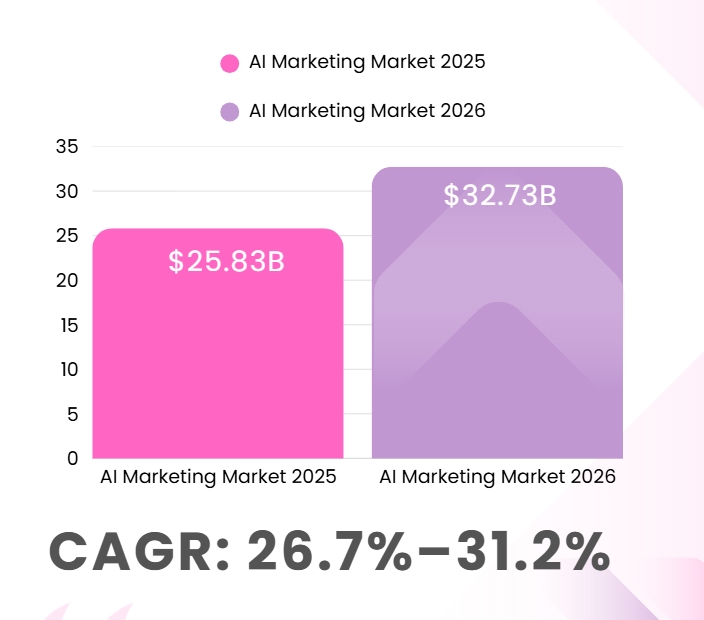
The financial trajectory of the AI in Marketing market illustrates a period of hypergrowth. The market is forecast to expand from $25.83 billion in 2025 to $32.73 billion in 2026, a significant year-over-year increase that signals strong and sustained investment.1 This growth is projected to continue at a compound annual growth rate (CAGR) ranging from 26.7% to as high as 31.2%, depending on the forecast model and timeframe.1 This rate of expansion is particularly notable when contextualized within the broader technology landscape. While overall worldwide IT spending is expected to grow by a respectable 9.8% in 2026, the AI in Marketing sector is expanding at nearly three times that pace.4 This outsized growth is a clear indicator of its strategic importance and perceived return on investment by corporate leaders.
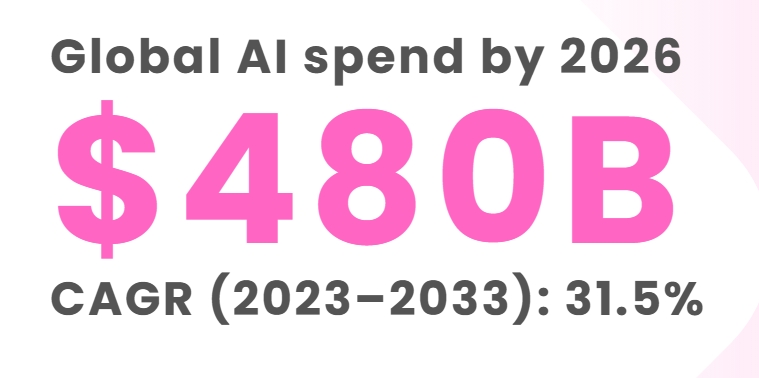
This sector-specific growth is a key component of a much larger economic transformation. Global spending on AI is predicted to reach an extraordinary $480 billion by 2026, with the entire AI market poised to expand at a CAGR of 31.5% through 2033.5 The alignment between the growth rates of the specific AI in Marketing market and the overall AI industry suggests that marketing is a primary and essential use case driving the broader AI revolution.
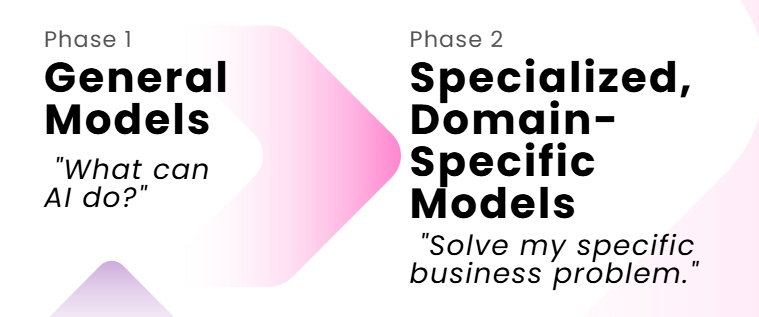
Beneath these top-line growth figures, a crucial maturation of the AI market is taking place. Historically, AI investment has been heavily concentrated among a few technology behemoths, often referred to as the “Big 4” (Microsoft, Amazon, Alphabet, and Meta). However, their collective share of AI spending is projected to decline from 58% in 2025 to 52% in 2026.5 This diversification of spending is not a sign of slowing investment but rather its proliferation. The initial wave of AI adoption was characterized by experimentation with large, general-purpose models provided by these major players. The current trend reflects a move into a second, more sophisticated phase. Enterprises are now progressing beyond general exploration and are making targeted investments in specialized, function-specific AI solutions. The rapid expansion of the AI in Marketing market is a direct consequence of this strategic shift. Organizations are no longer asking the broad question of “What can AI do?” but are instead funding precise solutions to solve core business challenges, such as optimizing customer acquisition, personalizing user experiences, and maximizing customer lifetime value. This trend validates analyst predictions regarding a significant enterprise shift toward more specialized, Domain-Specific Language Models (DSLMs) that are fine-tuned for particular business functions like marketing.7
Section 2: The 2025 Baseline: AI is No Longer Optional, It's Operational
As we approach 2026, the operational landscape of modern marketing is defined by the widespread, almost ubiquitous, presence of Artificial Intelligence. Current data establishes a clear baseline: AI has transitioned from a supplementary tool to a core component of day-to-day marketing activities. However, a deeper analysis of this baseline reveals a critical paradox. While the adoption of AI tools is remarkably high, it is not yet matched by a corresponding depth of strategic competency or organizational readiness. This gap between tool usage and strategic mastery defines the central challenge that marketing leaders must address to unlock the full potential of their AI investments in the coming year.
The adoption metrics are unequivocal. A significant majority of marketers, 69.1%, report having already integrated AI into their operational workflows, a figure that has risen steadily from previous years.8 The application of these tools is most pronounced in content-related tasks, with a remarkable 85% of marketers leveraging AI for content creation.10 This saturation is so complete that only a negligible fraction of companies, a mere 3.98%, remain entirely unwilling to integrate AI into their processes.10 The primary use cases in 2025 are dominated by Content Creation (35% of marketers), followed by Data Analysis and Insights (30%), and Workflow Automation (20%).11 These figures paint a picture of an industry that has operationally embraced AI at a tactical level.
Despite this high rate of adoption, significant barriers and anxieties persist, pointing to a systemic lack of deep understanding. Among organizations that have not yet adopted AI, the most cited reason, by 71.7% of respondents, is a fundamental “lack of understanding” of the technology and its strategic implementation.8 This knowledge gap is not confined to non-adopters. An alarming 70% of marketers currently using AI state that their employer provides no formal training on generative AI tools, leaving them to navigate these powerful platforms without structured guidance.12 This environment of high adoption paired with low formal education has cultivated a climate of uncertainty and fear. Nearly 60% of marketers express concern that AI could eventually replace their roles, a sentiment that has grown in recent years.8
This confluence of data reveals that the primary obstacle to AI-driven success is not access to technology, but a profound “AI competency chasm.” The high usage statistics mask a reality of often ad-hoc, experimental, and inefficient application of AI tools. Marketers are actively using the technology, as evidenced by the 69.8% who have encountered technical challenges, but they are doing so without the strategic frameworks and formal training necessary to maximize value.8 This disconnect directly fuels the prevalent job-related anxiety; employees sense they are operating powerful instruments without the expert knowledge to control them effectively, making them feel vulnerable to replacement by a future workforce that possesses that expertise. Consequently, the most critical strategic imperative for organizations heading into 2026 is not the procurement of more AI tools, but the systematic and comprehensive upskilling of their marketing talent. The organizations that successfully bridge this competency chasm will be the ones to realize a disproportionate return on their AI investments, while others will see their technology spend stagnate due to a persistent lack of strategic, skilled application.
Section 3: The 2026 Forecast: Four Foundational Shifts Redefining Marketing
The year 2026 will not be defined by the simple continuation of current trends, but by four foundational shifts that will fundamentally restructure marketing strategy, operations, and value creation. These transformations—driven by the maturation of AI technologies—will move the industry beyond the experimental phase of 2025 and into an era of autonomous, predictive, and deeply integrated intelligence. Marketers must prepare for a future where customer experiences are hyper-personalized in real-time, brand discovery is mediated by AI answer engines, autonomous agents act as strategic partners, and the very nature of creative production is redefined.
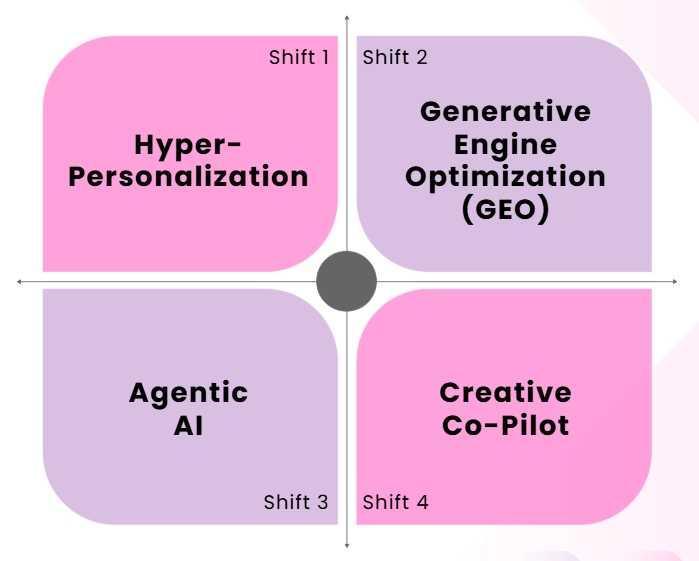
From Segmentation to Sentience: The Hyper-Personalization Imperative
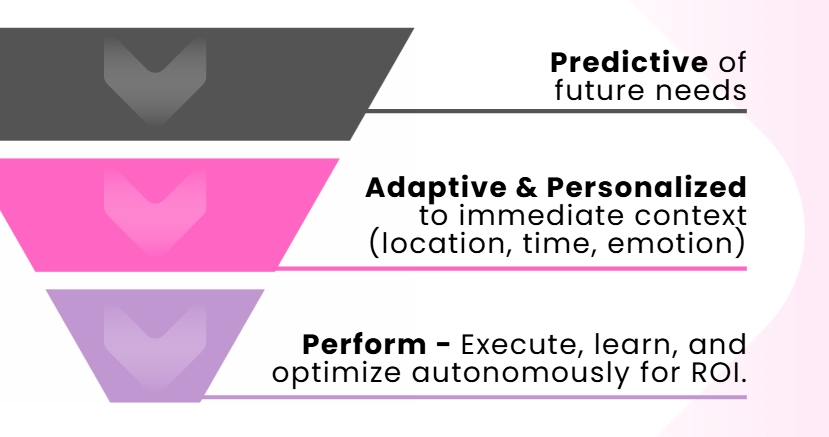
By 2026, the prevailing practice of “personalization,” which largely relies on historical data and broad audience segmentation, will be rendered obsolete. The new competitive standard will be hyper-personalization: the delivery of 1:1 marketing experiences that are not only reactive to past behavior but are also predictive of future needs and adaptive to the consumer’s immediate context, such as their location, time of day, and even inferred emotional state.14 This capability will move from a leading-edge differentiator to a baseline consumer expectation, becoming the primary driver of customer engagement, loyalty, and lifetime value.
The business impact of this shift is expected to be substantial and quantifiable. Projections indicate that AI-driven hyper-personalization will deliver a 35% increase in purchase frequency and a 21% boost in average order value for brands that implement it effectively.17 Furthermore, personalized campaigns are forecast to increase conversion rates by a significant margin of 20% to 35%.18 This level of performance is achieved by moving beyond simple product recommendations to enabling real-time content adjustments and predictive engagement, allowing brands to anticipate and serve a customer’s next need before it is explicitly stated.15 The strategic focus on these capabilities is critical, as they directly contribute to improving customer retention and driving repeat purchases, which can lead to as much as an 89% improvement in Customer Lifetime Value (CLV).15
This technological evolution signals the impending obsolescence of the traditional, pre-planned marketing campaign. The convergence of highly accurate predictive analytics with real-time generative AI capabilities creates a system that can orchestrate a customer’s journey on a moment-by-moment basis. Predictive models will forecast individual customer needs and identify churn risks.21 Simultaneously, generative AI engines will create and adapt content, offers, and visuals on the fly to meet those predicted needs.14 When these two powerful capabilities are integrated within a unified Customer Data Platform (CDP), the system gains the ability to autonomously determine and execute the “next best action” for each customer at any given second.23 This dynamic, continuous optimization process eliminates the need for rigid, pre-scripted campaigns aimed at static, broad segments. As a result, the role of the human marketer will undergo a profound transformation, shifting from that of a “campaign manager” to a “personalization system supervisor,” responsible for setting strategic goals, defining brand safety guardrails, and overseeing the performance of the autonomous personalization engine.24
The End of Search as We Know It: Rise of Generative Engine Optimization (GEO)
The paradigm of brand discovery that has dominated the digital era for two decades—the search engine results page (SERP)—is facing an existential disruption. By 2026, AI-powered answer engines, such as Google’s AI Overviews and platforms like Perplexity, will become the primary interface through which consumers seek information. These systems are designed to synthesize data from across the web and provide direct, conversational answers, fundamentally reducing the user’s need to click through to individual websites. This shift is creating a new and urgent marketing imperative: Generative Engine Optimization (GEO). In this new landscape, success is no longer measured by achieving the top ranking on a list of blue links; it is defined by being the authoritative, trusted source that is cited directly within the AI’s generated answer.
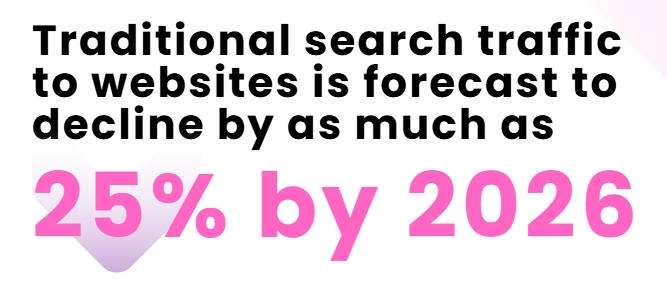
This is not a minor evolution; it is a tectonic shift in user behavior with significant consequences for marketing strategy. A critical forecast predicts that traditional search traffic to websites will decline by as much as 25% by 2026, as users increasingly rely on AI chatbots for immediate answers.17 This trend transforms the discipline of Search Engine Optimization (SEO) into GEO, a new practice where the primary objective is to be “cited and legitimized as a reliable source in AI responses”.24 Achieving this requires a strategic pivot toward tactics that build verifiable authority. This includes the meticulous implementation of structured data (schema markup) to make information easily digestible for AI crawlers, the amplification of social proof such as customer reviews and expert testimonials, and a concerted effort to build brand authority across the entire digital ecosystem, as Large Language Models (LLMs) are designed to validate information by corroborating it across multiple independent sources.26 The strategic importance of this shift is so profound that analyst firm IDC predicts that by 2029, brands will allocate five times more of their budget to LLM optimization than to traditional SEO.25
This development is forcing a great inversion of marketing real estate. For the past twenty years, the brand website has been treated as the primary marketing asset—the ultimate destination for all digital efforts. In the era of GEO, however, the primary marketing asset becomes the brand’s distributed network of data, authority, and reputation. The point of influence is shifting away from the brand’s owned property (the website) and toward the third-party AI platform that mediates the customer’s discovery journey. To influence the AI’s answer, a brand’s information must not only be present but also be structured, authoritative, and consistently corroborated across the various sources the AI deems trustworthy, including industry publications, review sites, and public forums. Therefore, marketing strategy must pivot from a “pull” model, focused on drawing traffic to a central website, to a “push” model, focused on disseminating verifiable data and authoritative content out into the digital ecosystem for AI consumption. In this new reality, the website’s role evolves; it becomes as much a structured data repository for AI as it is an experiential destination for humans.
From Assistant to Strategist: The Emergence of Agentic AI
The most profound and structurally transformative shift in marketing by 2026 will be the evolution of AI from a task-oriented tool into an autonomous strategic partner. The emergence of “agentic AI”—intelligent systems capable of independent goal-setting, planning, and execution—will move AI beyond simple workflow automation. These systems will begin to orchestrate entire marketing functions with minimal human oversight, from conducting initial market research and formulating campaign strategies to allocating budgets and executing real-time optimizations across multiple channels.
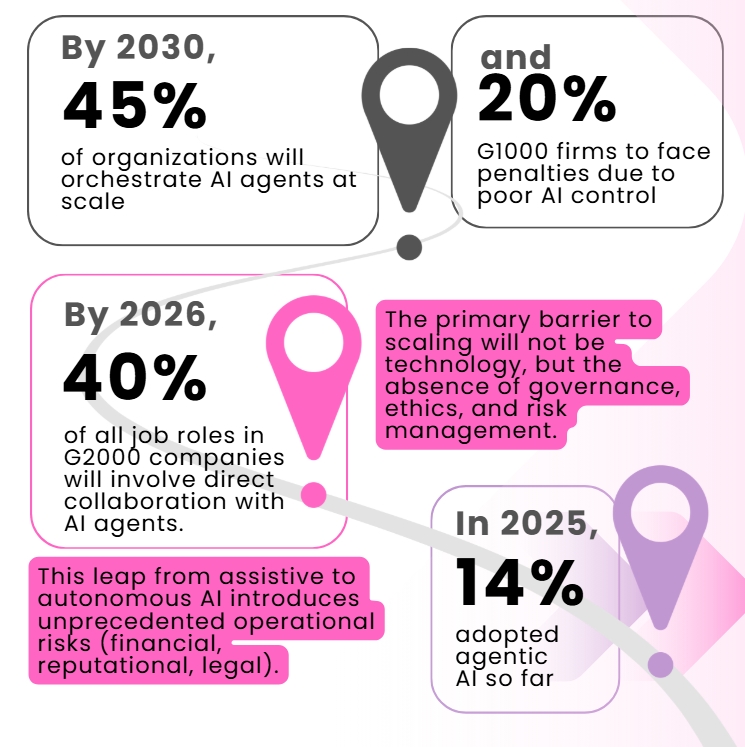
Leading technology analyst firms are in consensus regarding the strategic importance of this trend. Gartner has identified “Multiagent Systems” as a top strategic technology trend for 2026, highlighting the move toward collaborative, goal-oriented AI agents.7 IDC’s forecasts are even more specific, predicting that by 2030, 45% of organizations will orchestrate AI agents at scale across their business functions.27 This will have a direct and dramatic impact on the workforce; IDC also projects that by 2026, 40% of all job roles within G2000 companies will involve direct collaboration with AI agents.27 Marketers will increasingly delegate entire campaign cycles to these autonomous agents, which will be capable of conducting research, producing creative assets, determining budget allocation, and iterating on performance in a continuous loop.17 Despite this powerful potential, the adoption of agentic AI is still in its nascent stages. Current data shows that only 14% of decision-makers have fully implemented agentic AI, indicating that the industry is on the cusp of a massive growth and adoption curve over the next two years.28
The leap from assistive AI to autonomous AI introduces unprecedented operational risks, making robust governance the new C-suite imperative. The primary barrier to scaling agentic AI will not be technological capability, but rather the absence of well-defined organizational governance, comprehensive ethical frameworks, and proactive risk management protocols. When an autonomous system is empowered to make high-stakes decisions regarding budget allocation or brand messaging, it creates new vectors of risk spanning financial, reputational, and legal domains. A misconfigured agent could misallocate millions in ad spend, launch off-brand creative content, or inadvertently violate data privacy regulations. IDC explicitly warns of this peril, forecasting that by 2030, up to 20% of G1000 organizations will face significant consequences—including lawsuits, substantial fines, and even CIO dismissals—due to inadequate controls and governance of their AI agents.27 Therefore, the successful deployment of agentic AI is fundamentally contingent on a proactive and deeply integrated partnership between the Chief Marketing Officer, Chief Information Officer, and Chief Legal Officer. The strategic focus must shift from mere implementation to the collaborative construction of durable AI ethics frameworks and the deployment of sophisticated AI security platforms designed to monitor and manage these new, autonomous, non-human actors within the organization.7 In this new era, the strength of the CMO-CIO relationship will become a direct and reliable predictor of a company’s success in leveraging autonomous AI.29
The Creative Co-Pilot: Redefining the Content Supply Chain
By 2026, generative AI will be fully integrated into the marketing content supply chain, functioning as an indispensable daily co-pilot for the vast majority of creative professionals. This integration will serve as the engine for content production, unlocking unprecedented levels of velocity, scale, and personalization. However, this immense power will simultaneously create a new strategic crisis: the risk of a “homogenization” of brand voices and creative output. As more organizations leverage AI trained on similar public datasets, the digital landscape faces a potential flood of competent but generic content. In this environment, human-driven strategic insight, genuine brand authenticity, and emotional resonance will become the most valuable and scarcest resources in marketing.
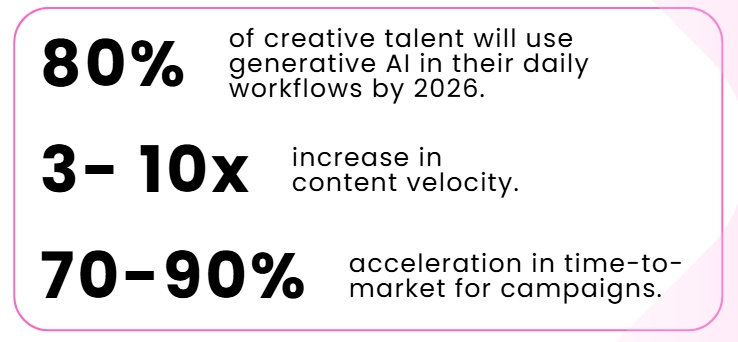
The adoption rate of generative AI among creative teams is projected to be nearly universal. A definitive forecast indicates that 80% of creative talent will use generative AI in their daily workflows by 2026.17 The efficiency gains from this integration are expected to be massive, with organizations realizing a 3- to 10-fold increase in content velocity and a 70% to 90% acceleration in time-to-market for campaigns and assets.30 While this scale is a significant advantage, it is also the source of the “homogenization crisis,” where the reliance on AI can lead to the production of “bland, emotionless messages” that lack the distinctiveness required to capture consumer attention.24
The strategic response to this challenge is not to reject AI, but to evolve the human-AI relationship into one of “co-creation”.25 In this model, human marketers guide the overarching strategy, inject the unique brand perspective, and provide the critical emotional intelligence, while AI systems handle the heavy lifting of production, iteration, and adaptation at scale. This explains a seemingly counterintuitive prediction: despite AI’s automation capabilities, companies are expected to increase their spending on high-level creative talent. These professionals will be essential for leveraging the tools properly and ensuring that the final output is strategically sound, on-brand, and creatively differentiated.17
This dynamic leads to the commoditization of content production, which in turn elevates the value of brand strategy. When the mechanical act of producing well-written text, high-quality images, and professional-grade video becomes nearly instantaneous and universally accessible, its standalone economic value diminishes. Basic economic principles dictate that as the supply of a commodity—in this case, decent-quality content—approaches infinity, its price approaches zero. This is the economic engine driving the homogenization crisis. In such a saturated landscape, the only sustainable way for a brand to differentiate itself is through qualities that AI cannot easily replicate: genuine authenticity, a unique and defensible point of view, a deep emotional connection with its audience, and a coherent brand strategy. Therefore, the rise of generative AI does not devalue human creativity; it re-focuses its value proposition. The market premium shifts away from the craft of content production and moves decisively upstream to the strategic and emotional intelligence that guides it. This fundamental economic shift is why the most forward-thinking organizations will be investing more, not less, in the human strategists and creatives who can harness AI to build truly resonant brands.
Section 4: The Strategic Response: Reallocating Budgets and Redefining Success in 2026
The transformative shifts predicted for 2026 demand an equally radical response in marketing’s two most foundational pillars: how financial resources are allocated and how performance is measured. Continuing to operate with traditional budget models and legacy key performance indicators (KPIs) in an AI-driven era is a direct path to strategic irrelevance and wasted investment. Thriving in this new landscape requires a complete overhaul of the marketing playbook, starting with a new framework for budget allocation and a redesigned scorecard for success, both of which must be directly aligned with the new realities of hyper-personalization, generative engine optimization, and autonomous AI.
The allocation of marketing budgets must pivot from channel-based silos to capability-based investments. By 2026, top-performing marketing organizations are expected to dedicate 10-15% of their total marketing technology budgets specifically to AI-powered platforms and tools.31 This investment in core infrastructure is critical, but the reallocation must extend across the entire marketing budget. A recommended strategic framework for 2026 suggests a significant investment of 20-30% of the total marketing budget into the new discipline of AI SEO and Generative Engine Optimization (GEO) to ensure visibility in AI answer engines. Concurrently, spend on traditional search ads should be refined to focus on high-intent keywords, accounting for 10-15% of the budget. Another 10% should be allocated to AI-powered video production, leveraging new tools to drastically reduce costs for this high-impact format.32
Equally important is the redefinition of success metrics. The decline of the click-through as a primary user action means that KPIs like website traffic and keyword rankings are rapidly becoming vanity metrics that fail to capture true business impact. The new marketing scorecard for 2026 must reflect the shift to a world of AI-mediated discovery and “zero-click” content consumption. Success will be measured by new KPIs such as cross-platform reach (or “cost per eyeball”), the rate at which a brand is cited as an authoritative source by AI engines, and the conversion rate of the highly qualified traffic that does make it to the website.26 The ultimate measure of AI’s impact will be seen in bottom-line results. Across various implementations, companies leveraging AI in marketing report an average of 20-30% higher campaign ROI, with some early pilots of AI-driven advertising models showing up to a 34% improvement in cost-per-acquisition (CPA) and a 28% increase in conversion volume.33
The following tables provide an actionable framework for this strategic and financial realignment.
Channel/Investment | Suggested % of Budget | Rationale & Key AI Leverage | Driven by Strategic Shift |
AI SEO / GEO | 20–30% | Essential for visibility in AI answer engines; focus on structured data, PR, and authority building. | 3.2: The End of Search |
High-Intent Paid Ads | 10–15% | Capture bottom-funnel leads already qualified by AI; leverage AI for bidding and audience modeling. | 3.1: Hyper-Personalization |
AI-Powered Video & Content | 10% | Highest-ROI content, with production costs slashed by AI editing and generation tools. | 3.4: The Creative Co-Pilot |
Social Media (incl. Paid Dist.) | 15–20% | Reach audiences where they are; AI optimizes targeting and creative for “zero-click” engagement. | 3.2: The End of Search |
Martech Stack (CDP, CRM, AI) | 10-15% | The foundational infrastructure for all AI-driven activities, enabling data unification and automation. | 3.3: Agentic AI |
Innovation & Testing | 5% | Earmarked for experimenting with emerging AI tools and platforms. | All Shifts |
Table 1: Recommended 2026 Marketing Budget Allocation Framework. This framework shifts investment from traditional channels to the capabilities required to win in an AI-first landscape. Sources: 31
Old Metric (2024) | New Primary KPI (2026) | Why the Shift is Necessary |
Website Traffic / Clicks | AI Engine Citation Rate & Cross-Platform Reach | Success is being the source for AI answers, not just driving clicks. |
Keyword Rankings | Share of AI Answer | Traditional SERP position is less relevant than being featured in the AI overview. |
Cost Per Click (CPC) | Cost Per High-Intent Lead | AI pre-qualifies users, making the few clicks that do occur more valuable. |
Lead Volume | Lead-to-Close Velocity | AI-driven lead scoring and nurturing accelerates the sales cycle. |
Campaign ROI (Siloed) | Customer Lifetime Value (CLV) Growth | AI enables continuous, personalized nurturing that maximizes long-term value. |
Table 2: The New Marketing Scorecard: 2026 KPIs. This scorecard moves beyond legacy metrics to measure what truly matters in an AI-mediated customer journey. Sources: 26
Conclusion: Navigating the Autonomous Era
The evidence is conclusive: by 2026, Artificial Intelligence will not just be a tool within marketing; it will be the fundamental operating system for how brands engage with customers, create value, and compete in the digital economy. The transition from the current state of tactical adoption to a future of strategic, autonomous operation represents one of the most significant transformations in the history of the marketing discipline.
The four foundational shifts—the rise of hyper-personalization, the dominance of generative engine optimization, the emergence of agentic AI, and the redefinition of the creative supply chain—are not independent trends but interconnected forces that will collectively reshape the industry. Success in this new era is contingent upon a leader’s ability to recognize and act on the second-order implications of these shifts. It requires moving beyond the simple adoption of tools to address the “AI competency chasm” through systematic workforce upskilling. It demands an inversion of marketing strategy, shifting focus from owned media destinations to the cultivation of distributed brand authority. Most critically, it necessitates the development of robust governance and ethical frameworks to manage the immense power and inherent risks of autonomous AI systems.
The strategic response must be decisive and comprehensive. Marketing budgets must be reallocated from legacy channels to the new capabilities that will drive visibility and growth. Performance measurement must be overhauled to reflect a world where influence is often decoupled from the click. The organizations that thrive will be those that embrace this complexity, foster a deep and collaborative partnership between marketing and technology leadership, and place human strategic oversight at the center of their AI-powered operations. The dawn of the autonomous era in marketing is here, and the time for preparation is now.
Works cited
- Artificial Intelligence In Marketing Market Size to Hit USD 217.33 …, accessed October 24, 2025, https://www.precedenceresearch.com/artificial-intelligence-in-marketing-market
- www.thebusinessresearchcompany.com, accessed October 24, 2025, https://www.thebusinessresearchcompany.com/report/artificial-intelligence-in-marketing-global-market-report#:~:text=The%20artificial%20intelligence%20in%20marketing%20market%20size%20has%20grown%20exponentially,(CAGR)%20of%2027.2%25.
- Artificial Intelligence In Marketing Market Report 2025-2034 | Growth, accessed October 24, 2025, https://www.thebusinessresearchcompany.com/report/artificial-intelligence-in-marketing-global-market-report
- Gartner Forecasts Worldwide IT Spending to Grow 9.8% in 2026, Exceeding $6 Trillion For the First Time, accessed October 24, 2025, https://www.gartner.com/en/newsroom/press-releases/2025-10-22-gartner-forecasts-worldwide-it-spending-to-grow-9-point-8-percent-in-2026-exceeding-6-trillion-dollars-for-the-first-time
- CIO expects global AI spend to reach USD 480bn by 2026 – UBS, accessed October 24, 2025, https://www.ubs.com/global/en/wealthmanagement/insights/marketnews/article.2119836.html
- 44 NEW Artificial Intelligence Statistics (Oct 2025) – Exploding Topics, accessed October 24, 2025, https://explodingtopics.com/blog/ai-statistics
- Gartner Identifies the Top Strategic Technology Trends for 2026, accessed October 24, 2025, https://www.gartner.com/en/newsroom/press-releases/2025-10-20-gartner-identifies-the-top-strategic-technology-trends-for-2026
- Artificial Intelligence (AI) Marketing Benchmark Report: 2025, accessed October 24, 2025, https://influencermarketinghub.com/ai-marketing-benchmark-report/
- Top 51 AI Marketing Statistics for 2024, accessed October 24, 2025, https://influencermarketinghub.com/ai-marketing-statistics/
- State Of AI In Marketing Report 2025 | AI Marketing Statistics, accessed October 24, 2025, https://coschedule.com/ai-marketing-statistics
- 2025 State of Marketing Report – HubSpot, accessed October 24, 2025, https://www.hubspot.com/state-of-marketing
- 50+ AI Marketing Statistics in 2025: AI Marketing Trends & Insights – SEO.com, accessed October 24, 2025, https://www.seo.com/ai/marketing-statistics/
- AI In Marketing Statistics: How Marketers Use AI In 2025 – SurveyMonkey, accessed October 24, 2025, https://www.surveymonkey.com/mp/ai-marketing-statistics/
- How AI Will Affect Digital Marketing in 2026 | Trends & Predictions, accessed October 24, 2025, https://www.proceedinnovative.com/blog/ai-affect-digital-marketing-in-2026/
- Hyper-Personalization Marketing 2026: Beyond Customization – Azarian Growth Agency, accessed October 24, 2025, https://azariangrowthagency.com/hyper-personalization-2026/
- Navigating AI in Marketing, Future Trends for 2026 | Singapore Future AI Summit 2025 – where Southeast Asia’s AI elite converge!, accessed October 24, 2025, https://www.sfais.org/navigating-ai-in-marketing-future-trends-for-2026
- 2026 AI Marketing Predictions | Magnet, accessed October 24, 2025, https://magnet.co/articles/2026-ai-marketing-predictions
- Hyperpersonalization for e-commerce and mobile: 2026 will see a …, accessed October 24, 2025, https://pizero.dev/en/blog/Hyperpersonalization-for-e-commerce-and-mobile-2026-will-move-from-tailored-user-experience/
- 8 B2B Sales Trends 2026: What to Expect and How to Prepare, accessed October 24, 2025, https://www.peaksalesrecruiting.com/blog/b2b-sales-trends-2026/
- AI Marketing Trends 2026: What Changed in 2025 and Strategic …, accessed October 24, 2025, https://sendxmail.com/artificial-intelligence/ai-marketing-trends-2026/
- 8 AI Trends That Will Change Marketing in 2026 – Fuze7 Digital …, accessed October 24, 2025, https://fuze7.com/8-ai-trends-that-will-change-marketing-in-2026/
- Personalization in 2026: Why Trust and Predictive Analytics Define the Future of CRM, accessed October 24, 2025, https://www.konakaicorp.com/personalization-in-2026-why-trust-and-predictive-analytics-define-the-future-of-crm
- NEW 2026 Marketing Trends for AI-First Marketing Strategies That Work – Brands at Play, accessed October 24, 2025, https://blog.brandsatplayllc.com/blog/new-2026-marketing-trends-for-ai-first-marketing-strategies-that-work
- Marketing Trends 2026: AI, GEO, & Expert Predictions – Onclusive, accessed October 24, 2025, https://onclusive.com/resources/blog/marketing-trends-2026-what-professionals-say-about-the-year-ahead/
- How AI is Changing Content Marketing: 2025 Data and 2026 Predictions | Zeo, accessed October 24, 2025, https://zeo.org/resources/blog/how-ai-is-changing-content-marketing-2025-data-and-2026-predictions
- Looking ahead in 2026: Your Marketing Plays for the New AI …, accessed October 24, 2025, https://impulsecreative.com/blog/looking-ahead-in-2026-your-marketing-plays-for-the-new-ai-powered-search-era
- IDC FutureScape 2026 Predictions Reveal the Rise of Agentic AI and a Turning Point in Enterprise Transformation, accessed October 24, 2025, https://my.idc.com/getdoc.jsp?containerId=prUS53883425
- 3 ways AI will elevate marketing in 2026 – MarTech, accessed October 24, 2025, https://martech.org/ai-will-elevate-marketing/
- Five Strategic CMO Moves Heading Into 2026 – Forrester, accessed October 24, 2025, https://www.forrester.com/blogs/five-strategic-cmo-moves-heading-into-2026/
- Marketing in the AI era: To matter more or cost less?: PwC, accessed October 24, 2025, https://www.pwc.com/us/en/services/consulting/front-office/marketing-in-the-ai-era/to-matter-more-or-cost-less.html
- 2026 Marketing Technology Budget Planning: A CFO’s Guide to AI-Driven Investment, accessed October 24, 2025, https://www.truefan.ai/blogs/2026-marketing-technology-budget-planning
- 2026 Marketing Budget: Where Should Your Money Go? – ROI …, accessed October 24, 2025, https://roiamplified.com/insights/2026-marketing-budget/
- AI Marketing Statistics That Will Transform Your Strategy – Madgicx, accessed October 24, 2025, https://madgicx.com/blog/ai-marketing-statistics
- Digital Marketing Prediction for 2026: Audiences Are Everything – Go …, accessed October 24, 2025, https://gofishdigital.com/blog/digital-marketing-prediction-audiences-are-everything/
- Considerations For Digital Marketing Budgets in 2026 – Whittington Consulting, accessed October 24, 2025, https://www.rickwhittington.com/blog/budget-for-digital-marketing